
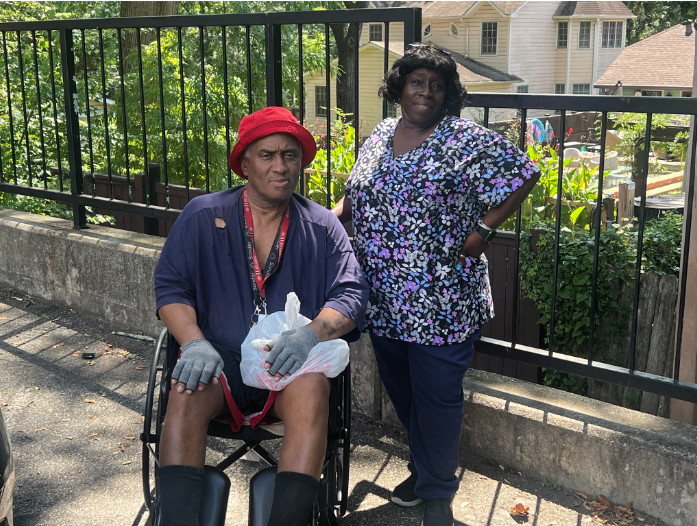
Years ago, Rubin was involved in a car accident. Doctors believed he suffered only a minor spinal injury. But according to Rubin, the injury wasn’t properly treated. Over time, what seemed small became life changing. Years later, inflammation around his spine caused irreversible nerve damage, gradually taking away his mobility.
For most of his life, Rubin believed hard work could carry you through almost anything. Living in Atlanta, Rubin often worked two full time jobs, taking pride in being able to provide for himself.
Today, Rubin depends on a wheelchair and the daily support of a caregiver. The hardest part, he says, wasn’t learning how to live with physical limitations.
It was learning how to accept help.
“I’ve always been the one taking care of myself,” he says. “Now I need people for things I never thought I’d need.”
That included applying for SNAP benefits.
The paperwork was difficult enough, but what surprised him most was how some people treated him once they knew he was receiving assistance.
One afternoon, after carefully budgeting his SNAP benefits for weeks, Rubin decided to buy himself a steak. It wasn’t a luxury purchase. It was kind of like a reward.
As the cashier scanned his groceries and noticed his EBT card, they looked at the steak and said, “It must be nice to eat this good.”
Rubin remembers standing there in silence.
“They didn’t know I’d planned for that steak. They didn’t know I’d spent weeks making every dollar count.
They didn’t know my story.”
I asked him why that story came up for him when asked about his SNAP usage experience. He didn’t tell that story because he’s still angry. He told it because he hopes people will pause before making assumptions.
Rubin has watched more neighbors rely on public assistance than ever before. To him, that isn’t a sign that people are failing. It’s a reminder that life is unpredictable.
In a single moment, anyone could find themselves needing the programs once assumed were meant for someone else.
Rubin doesn’t ask for sympathy. In his own way, he asks for understanding. He hopes that one day an EBT card won’t be seen as a symbol of failure, but as a community choosing to care for its neighbors.
Just as we build sidewalks for those who cannot walk with ease and ramps for those who use wheelchairs, programs, like SNAP, help ensure illness, injury, or unexpected hardship don’t also become hunger. In the end, none of us knows when life might change. When life changes, compassion and not judgment is what helps people find their way forward. After all, as Rubin says, “Life happens.”