
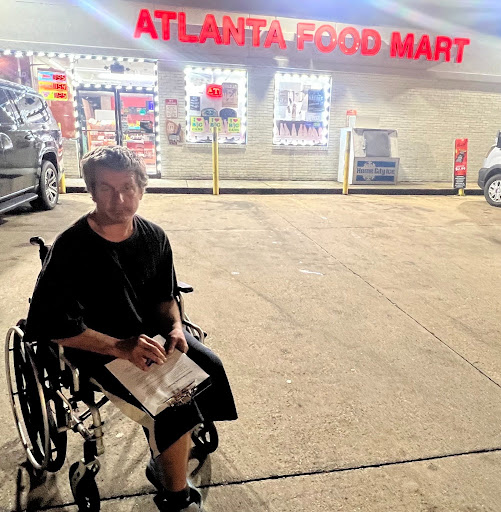
At the counter of the Atlanta Food Mart, Brent moved his wheelchair forward, reaching his arm to place a spotted banana and Dasani bottled water within the cashier’s reach.
When it was time to pay, he pulled out a Bank of America debit card and a green Electronic Benefit Transfer (EBT) card with a large Georgia peach on it. After some shuffling, Brent used his EBT card.
Brent is grateful to have EBT at all. “Keeping my food stamps has sometimes been as hard as it is to get to the store,” he said.
Brent described the time when he lost his Supplemental Nutrition Assistance Program (SNAP) benefits, the federal program formerly known as food stamps, during a long hospital stay. His cell phone was cut off, and no one alerted him that his SNAP benefits expired.
Having Something Decent Like A Banana
“All of that was eventually worked out, thankfully,” Brent said. “I’m very happy when I have my food stamps. It’s the difference between feeling like crap from canned ravioli and having something decent like this banana and bottled water.”
“A lot of people are saying a lot of things about the food stamps, I don’t know what’s going to happen,” he continued. “I just hope my caseworker keeps me updated. I’m going to keep a working phone so I don’t miss anything.”
For Brent, SNAP is not an abstract program filled with political issues. SNAP gives Brent stability.
“I don’t get into politics,” he said. “But people are making decisions about situations they’ve never experienced.”
He looks directly at me for the first time in the conversation.
“When you’re in a wheelchair, people don’t always respect you. They don’t plan for you when they’re thinking about big changes,” he said.
In communities where development assumes a person’s mobility, food access can depend not just on income, but whether people are seen or considered at all.
A banana at the mini mart may seem small, but for Brent it’s a moment where access, mobility, and SNAP funds come together – even if it’s just for a brief moment.