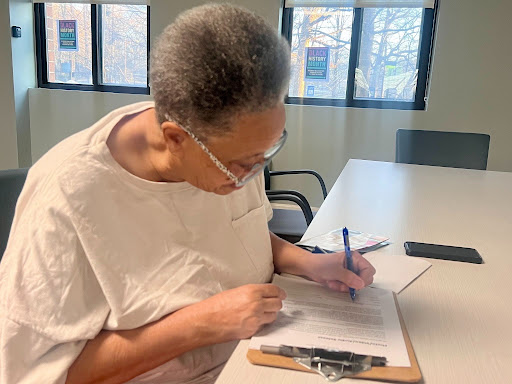
Ms. Nancy prefers mornings.
“7:00,” she told me firmly when we confirmed our meeting.
I arrive at 7:11. Nancy’s gray eyes are the first thing you notice about her along with neatly trimmed, silver-platinum hair.
“It’s going to be all right,” she said as I entered her apartment. “We’re going to make it.” This is her signature response, greeting, and ending.
Nancy’s family is originally from Hogansville, GA. She grew up in Atlanta, spending her younger years in Atlanta. She describes the “flat houses,” of her neighborhood in Reynoldstown, homes where you could open the front door and see straight through to the back with everything on one level.
“Now it’s all high houses,” she said. “High houses everywhere. And they’re expensive, too.”
Back then, neighbors grew food. Gardens were common. Chickens, too.
“We ate what we grew often,” she said. “Then we’d go to the store for the rest.”
Today, she eats mostly vegetables like onions, spinach, and tomatoes. Rarely chicken or beef. Fish occasionally.
“That’s what I use most of my SNAP card for,” she said.
When her SNAP benefits were temporarily interrupted due to the government shutdown in 2025, Nancy was frightened.
“It was confusing,” she said. “They told me at my age I didn’t have to recertify. That it would renew automatically.”
“That was scary,” she said. “You don’t know what’s going to happen anymore.”
The benefits were restored, but the interruption reminded her of an old habit formed in those flat houses.
“You put a little to the side,” she said. “A couple cans here and there. Pasta. Tuna fish. You save.”
Nancy participates in one of Wholesome Wave Georgia’s free produce markets held at her senior building. Unlike many residents, she still has transportation. She has also traveled to East Atlanta Village, where SNAP dollars can be doubled at participating markets.
“I like that,” she said. “It stretches it, I had a good time.”
True to form, she did not go alone. As she once transported students and families across the city in school buses, she made a point of bringing a neighbor along to share the experience.
“You don’t keep things to yourself,” she said. “If something helps you, you tell somebody else.”
At 73, with high blood pressure, glaucoma, and other health concerns, the possibility of losing SNAP still creates stress.
“Sometimes I think about it being cut off,” she admitted. “But God knows different.”
Before I left, she said it once more.
“It’s going to be all right. We’re going to make it.”
For Nancy, SNAP is not a charity. It is part of the steady discipline that has defined her life – stretching, saving, sharing. In a city that has grown taller and more expensive, she continues to move forward the way she always has: thoughtful, prepared, and determined not to keep a blessing to herself.
“We’re going to make it,” she repeated.